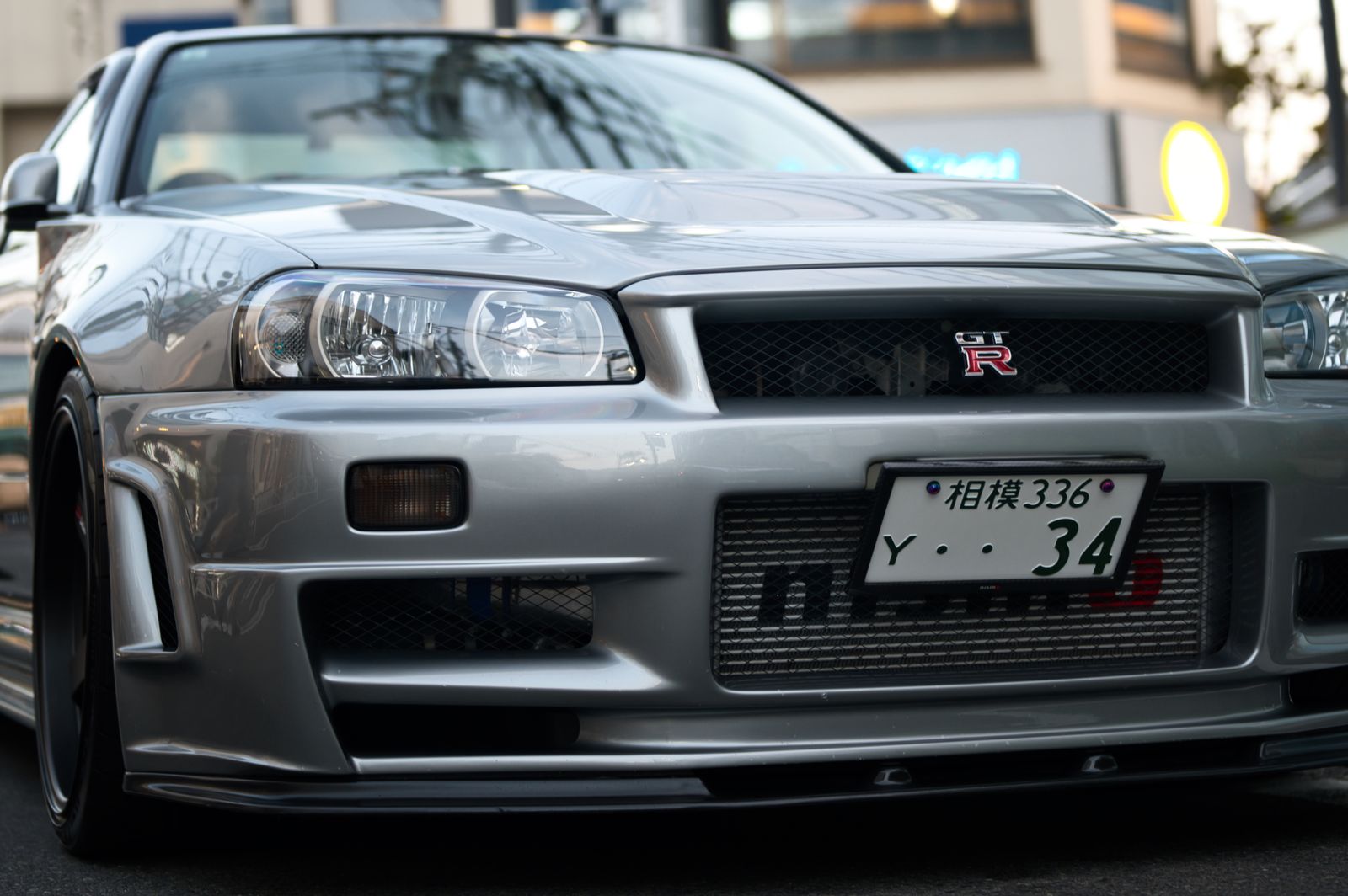
Nissan Skyline OEM Parts: Identify the Part, Not Just the Generation
A Japanese listing might describe an item as “R34 Skyline genuine bumper” and show a clean part on a warehouse floor. That description is a starting point, not a fitment confirmation.
The important questions are more specific: Which model? Which production period? Which body configuration? Is the component genuinely original, and does the seller have the exact piece photographed?
For discontinued parts, a mistake can cost more than the purchase price. International freight, fragile trim, missing mounting hardware and restrictive returns can turn a cheap listing into an expensive lesson.
Here is how to build a parts request that a Japanese supplier can investigate properly.
First, identify the actual car
“R32,” “R33,” and “R34” describe Skyline generations. They do not identify a single parts configuration. The familiar GT-R codes are BNR32, BCNR33 and BNR34, but other Skyline variants have their own model and chassis identifiers.
Record the full identification from the vehicle plate and supporting paperwork. Include production month/year, body style, grade, engine, transmission and any equipment relevant to the part. Japanese-market cars may use a frame or chassis number rather than the standard 17-character VIN expected by many US websites.
Practical distinction: An R34 GT-T and an R34 GT-R should not be treated as interchangeable parts donors. Even where a component appears similar, the mounting geometry or associated hardware may differ. Verify the particular part rather than relying on the badge.
A real OEM-number example: R34 GT-R right front fender
NISMO's official Heritage Parts catalog lists 63112-RHR40 as a reproduced right front fender for the BNR34 Skyline GT-R, with former Nissan OEM number 63112-AA430 and catalog application beginning January 1999.
That gives an enthusiast three distinct things to verify: the current NISMO ordering number, the historical Nissan number and the precise application. The two numbers are not interchangeable search shortcuts: the catalog specifically notes that the former Nissan number is not the number to use for ordering the Heritage reproduction.
What this does not prove: It does not establish fitment on an ER34 GT-T, confirm current stock or include all clips, brackets, paint or shipping. Before buying, verify the vehicle identification and the latest official catalog listing, then ask the supplier what is included and whether the item can actually be supplied.
Official catalog: NISMO Heritage Parts
What the same process looks like for a GT-T bumper
Suppose an ER34 owner finds a listing for an “R34 genuine front bumper.” This is a hypothetical inquiry, not a verified listing or a documented Nissan bumper part number. The buyer should supply the full chassis/model information and production date, then request rear-side photos, mounting points, markings and a list of included hardware. Do not substitute the BNR34 fender example above as evidence of ER34 compatibility.
| What to verify | Why it matters |
|---|---|
| Full model/chassis code and production date | “R34” alone is not a fitment application |
| Complete part number and its source | Similar-looking components may have different applications |
| Front and rear photos, mounting tabs and labels | Shows what is actually being sold |
| Repairs, paint, missing hardware and return terms | Determines condition and purchase risk |
| Packed dimensions and delivered cost | Oversize bodywork can be expensive to import |
An important distinction: NISMO Heritage is not a universal Skyline parts catalog
NISMO's Heritage Parts program has explicitly covered the GT-R applications BNR32, BCNR33 and BNR34, including selected exterior and maintenance components. That does not mean an R34 GT-T (ER34) is covered, nor that every historical Heritage part is available today.
If a listing advertises a “Heritage” component, check the program's published application and part number. Do not assume that a GT-R Heritage item is an original ER34 part or a bolt-on upgrade.
Official reference: NISMO's 2018 expansion notice documents the covered GT-R chassis and directs readers to detailed application information: Read NISMO's official 2018 announcement (PDF) ↗
How to handle Nissan part numbers and supersessions
A complete Nissan part number is more useful than a generic description. Record the entire identifier exactly as shown, including any suffix, rather than searching by the first few characters alone.
Do not assume a shared prefix or a similar suffix proves interchangeability. A catalog may show different numbers for production changes, finishes, assemblies or service replacements. A superseded number is meaningful only when a trustworthy catalog or qualified specialist confirms the replacement applies to the specific vehicle.
Where an original component has a stamped or molded number, photograph it. Remember that a molded manufacturing identifier is not always the complete service part number.
For vehicles not covered by a public US-market catalog, avoid treating the absence of a listing as proof that the Japanese-market component never existed.
Read Japanese listings for evidence, not just keywords
Useful Japanese search and listing terms include:
| Japanese | Common meaning | Why it matters |
|---|---|---|
| 純正 (junsei) | Genuine / original equipment | A seller's claim that the part is OEM, still requiring verification |
| 中古 (chūko) | Used | Expect condition-specific questions |
| 未使用 (mishiyō) | Unused | Does not automatically mean recently manufactured |
| 左 / 右 (hidari / migi) | Left / right | Essential for side-specific components |
| 傷 (kizu) | Scratch / damage | Look for condition notes and close-up photographs |
| 欠品 (ketsuhin) | Missing item / component | Check clips, brackets, covers and hardware |
| 品番 (hinban) | Part number | Ask for the complete number when available |
| 適合 (tekigō) | Compatibility / application | Verify the seller's claim against the actual vehicle |
These are reading aids, not guarantees of authenticity or fitment. Machine translation can obscure important condition notes. When a listing is ambiguous, request clarification before paying.
The five photographs worth requesting
For an exterior component, ask for the front face, reverse side, every mounting point, any labels or molded markings, and close-ups of damage or repairs.
For an electrical component, prioritize connectors, pins, markings and the complete housing. For mechanical parts, request the identifying information and relevant condition evidence, then have a qualified technician assess suitability.
A “genuine Nissan” sticker cannot substitute for application and condition checks.
Availability is separate from fitment
A component may be the correct OEM part but no longer available through a normal retail channel. Conversely, a used component may be available in Japan without being correct for the customer's car.
State whether you will accept new OEM, unused older stock, used OEM, refurbished OEM or an aftermarket alternative. These are different categories and should never be silently substituted.
For steering, braking, suspension or other safety-critical systems, obtain professional inspection and verification. Do not infer safety or compatibility from photographs.
Calculate the delivered cost before committing
The listing price may exclude transport within Japan, export packaging, international freight, import duties or fees, and payment charges. Oversized bumpers and fragile trim can be costly to package and ship.
Ask for the condition, included hardware, packing method, destination-based delivered estimate and return terms in writing. Do not treat a sourcing inquiry as a confirmed order.
A request a supplier can actually investigate
Send the full vehicle identification, production details, exact part name, any verified OEM number, photographs, acceptable condition, quantity and destination postal code. Add your budget or deadline if either is a constraint.
No part number yet? Say that clearly. A photo of the removed component and the vehicle's identification are more helpful than a guessed number.
How Hashi Auto approaches the request
Hashi Auto provides request-based Japanese automotive parts sourcing. The starting point is identifying the component precisely enough to ask meaningful questions of potential suppliers. We then review possible availability and condition evidence case by case.
We do not maintain a general inventory, guarantee that a discontinued part exists, or promise fitment based only on a seller's listing. Any sourcing and pricing proposal requires review before payment.
Submit a Skyline parts inquiry ↗
Include the chassis details and photos you have.
For vehicle-level background, read the Skyline R32 to R34 sourcing guide or visit the JDM Parts Knowledge Center.